
A Living History of Filigree
Filigree is often described as delicate, but for me it has always been something more deliberate. It is precise and ordered, built from repeatable actions that echo the logic of geometry and structure, yet it is also deeply expressive. Within those constraints there is room for intuition, emotion, and choice. This balance—between control and freedom—is where filigree comes alive for me.
Working with filigree means slowing down and paying attention. It asks for planning and discipline, but it also asks for responsiveness: listening to how the wire moves, how heat travels, how space begins to define the form. Across thousands of years, artisans in many cultures have returned to this same impulse—shaping fine metal wire into structures that carry meaning as well as beauty.
This is not meant to be a technical history or an academic survey. It is a reflective view of how filigree developed, how it traveled across cultures, and why it continues to resonate—especially for those of us who work within this tradition today.
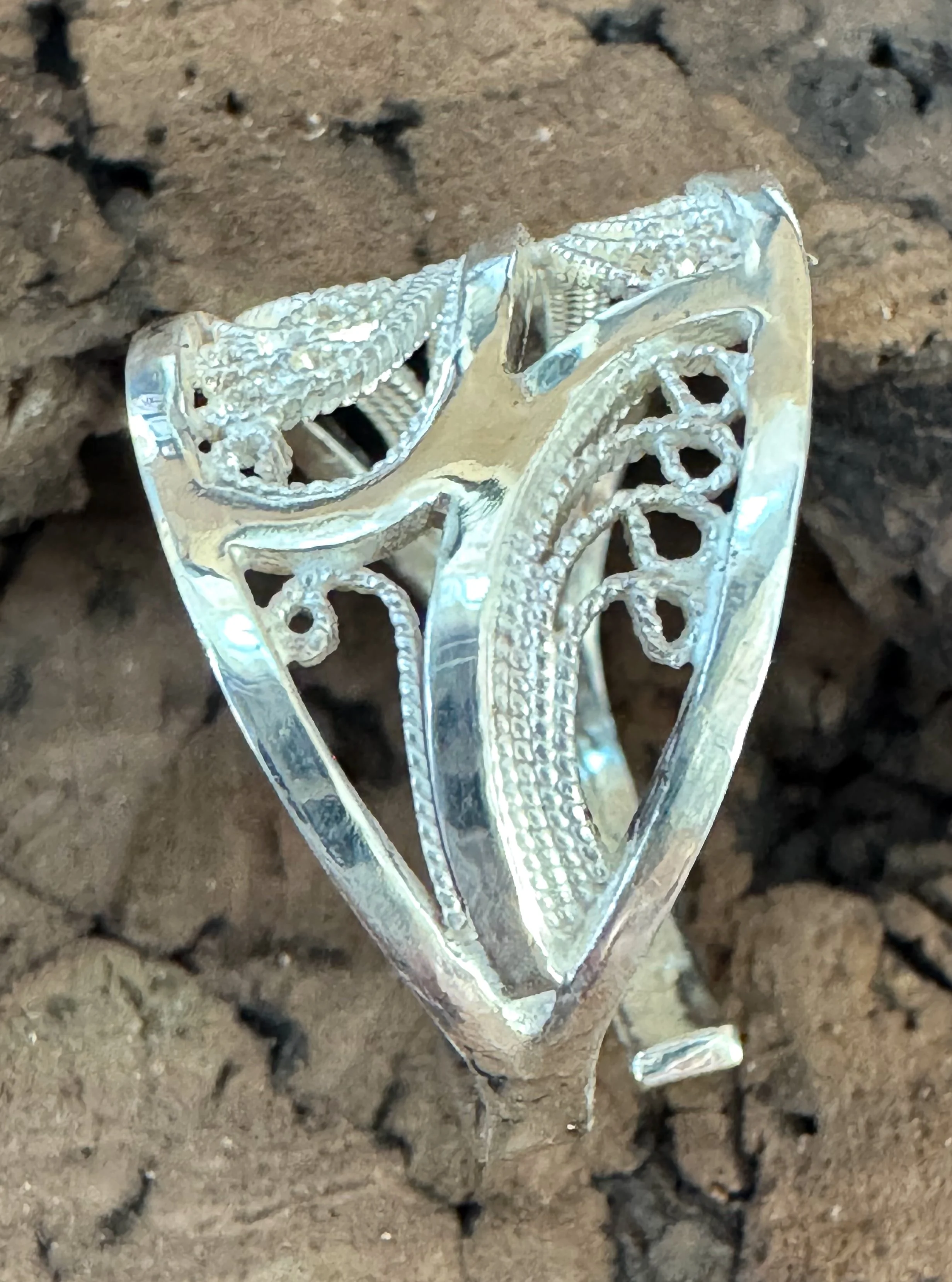
Contemporary filigree ring exploring structure, repetition, and negative space.
Ancient Beginnings: Early Mastery of Wire (c. 3000 BCE – 500 CE)
The earliest examples of filigree appear in ancient Mesopotamia and Egypt around 3000 BCE. Goldsmiths discovered that gold, because of its softness and resistance to corrosion, could be drawn into extremely fine wires. These wires were twisted, coiled, and soldered into simple geometric and linear patterns that decorated jewelry, ceremonial objects, and amulets. The designs were often symmetrical and symbolic, reflecting religious beliefs and social structure.
Gold filigree earrings from the Royal Cemetery of Ur (c. 2600 BCE) show how advanced these techniques already were. These pieces were created for elite burials, underscoring filigree’s early association with status, reverence, and technical skill. Even at this early stage, filigree required careful planning and control—each wire placed with intention, each joint executed with precision.
In ancient Greece and Rome, filigree became increasingly refined, guided by proportional thinking and an intuitive understanding of balance. Greek jewelers favored organic motifs such as vines, leaves, and scrolls, while Etruscan artisans perfected the combination of filigree with granulation—placing tiny metal beads alongside wire to create texture and depth. Jewelry from this period demonstrates a remarkable balance between intricacy and restraint. Technical mastery served beauty rather than overshadowing it, allowing complexity to feel light and effortless.
Sacred Meaning and Cultural Exchange (500 CE – 1400 CE)
During the Byzantine period, filigree took on a strong religious role. Artisans used fine gold and silver wire to decorate crosses, reliquaries, and other sacred objects. Filigree was often combined with cloisonné enamel and gemstones, and advances in soldering allowed for more complex and durable structures. These objects were meant to endure, both physically and spiritually, and the care invested in their making reflected their devotional purpose.
At the same time, Islamic metalworkers developed highly refined filigree traditions characterized by intricate, lace-like patterns. Through trade routes connecting Europe, the Middle East, and Asia, techniques and ideas were exchanged freely. Filigree became a shared language—adapted to local aesthetics while maintaining its essential principles of rhythm, repetition, and balance.In India, filigree evolved along its own continuous path. Known as Tarakasi, Indian silver filigree flourished particularly in Cuttack, Odisha. Artisans wove extraordinarily fine silver wires into dense yet airy forms used for ceremonial objects, jewelry, and items connected to daily ritual. These works show how technical rigor and cultural meaning can exist side by side, with utility and ornament inseparable from one another.
Filigree Traditions in China (c. 700 BCE – Qing Dynasty, 1644–1912 CE)
In China, filigree developed early and independently, with documented use dating back to at least the late Zhou Dynasty (c. 700–256 BCE). It reached exceptional refinement during the Han, Tang, and Ming dynasties, where it was closely tied to imperial workshops and court culture. Known as jian si (literally “thread drawing”), Chinese filigree relied on drawing gold and silver into extremely fine wires that were then twisted, shaped, and soldered into intricate motifs.
These techniques were used in jewelry, hair ornaments, and ceremonial objects, often incorporating auspicious symbols such as clouds, phoenixes, dragons, and floral forms. Precision, symmetry, and control were essential, but the work also emphasized elegance and fluidity. Filigree in China reflects a deep respect for technical mastery paired with symbolic meaning—work that is exacting in its construction yet graceful in its expression.
Filigree Traditions in the Americas (c. 1200 BCE – Present)
In the Americas, filigree traditions developed through both Indigenous innovation and later cultural exchange. Pre-Columbian Andean metalworking traditions date back at least to c. 1200 BCE, with sophisticated goldworking flourishing among cultures such as the Chavín, Moche, Sicán, and later the Inca (c. 1200–1533 CE). These metalworkers achieved extraordinary mastery of gold, creating objects that emphasized lightness, movement, and transformation.
While Andean works did not always take the form of classical soldered filigree, artisans used drawn wire, twisting, and openwork techniques to create complex, lightweight structures that functioned visually and conceptually like filigree. According to research by the Metropolitan Museum of Art, these objects emphasized radiance and the relationship between material, light, and power. Metal was shaped to appear fluid and animated, blurring the boundary between structure and ornament.
Following European colonization, filigree techniques were introduced more directly into the Americas through Spanish and Portuguese influence. Over time, these methods merged with Indigenous aesthetics and local materials, giving rise to distinct regional filigree traditions in places such as Mexico, Colombia, Peru, and Brazil. These works remain expressive and adaptable, deeply connected to place and cultural identity.
Renaissance and Baroque: Technique and Expression (1400 CE –1700 CE)
The Renaissance brought renewed interest in classical forms and greater technical precision, supported by improved tools and a growing attention to proportion, repeatability, and structural logic. Jewelers began to think more consciously about how individual elements related to the whole, creating layered filigree designs with increased dimensionality.
During the Baroque period, filigree grew more expressive and dramatic. Bold curves, dense scrollwork, and strong contrasts between solid metal and open space became common. Filigree was no longer purely subtle; it carried movement and emotion, using technical complexity to amplify visual impact.
In the Iberian Peninsula, filigree became closely tied to regional identity. Portuguese gold filigree, especially the heart-shaped Coração de Viana, emerged as a symbol of love, faith, and devotion. Silver became more widely used alongside gold, expanding filigree’s presence while preserving its symbolic and cultural significance.
Regional Traditions and Continuity (1700 CE – 1900 CE)
As filigree spread through Europe, the Middle East, and the Americas, distinct regional styles developed. In Yemen and Oman, silver filigree jewelry featured bold patterns tied to traditional dress and cultural customs. In Italy, filigree remained closely associated with devotional objects and household religious items, maintaining a quiet intimacy even as styles evolved.
A 19th-century Italian silver filigree reliquary reflects this continuity. Even as industrialization transformed many aspects of metal production, filigree resisted full mechanization. Its reliance on hand skills, judgment, and patience kept it rooted in the human touch—each piece bearing the marks of time, care, and decision-making.
Filigree Today: Tradition and Exploration (1900 CE – Present)
In the twentieth and twenty-first centuries, filigree has continued to evolve, shaped by both continuity and questioning. While historical techniques remain the foundation, many contemporary jewelers no longer approach filigree as surface ornament alone. Instead, it has become a way of thinking through structure, space, and movement.
Technical understanding remains central. As Oppi Untracht describes in Jewelry Concepts and Technology, true filigree depends on precise control of wire gauge, heat, and solder flow, with each wire functioning as part of an integrated whole. This structural mindset encourages work that is intentional and self-supporting, where complexity is resolved through planning rather than excess.
At the same time, contemporary practice places equal value on sensitivity and presence. In Metalsmith Magazine and Art Jewelry Forum writings, filigree is discussed in relation to process, labor, and material awareness. Transparency, repetition, and negative space become expressive tools, and the visibility of the hand—the trace of time and choice—becomes part of the meaning of the work. Used sculpturally, filigree allows metal to behave almost like drawing in space, creating volume and movement while remaining visibly constructed. Seen this way, filigree is not a fixed historical style but a living language—adaptable, responsive, and open to interpretation.
An Enduring Language
From ancient burial goods to contemporary art jewelry, filigree has endured because it asks something of both maker and viewer. It values patience, balance, and intention. It treats air and space as essential elements of design, giving equal importance to what is present and what is left open.
For me, filigree is not simply a historical technique, nor only an exercise in technical mastery. It is a way of thinking through material—where structure and repetition coexist with intuition and feeling. This balance, between precision and expression, is what has allowed filigree to persist across cultures and centuries, and what continues to make it a powerful and relevant form of artistic expression today.
This article was generated with the assistance of ChatGPT.
Sources and References
Metropolitan Museum of Art. Heilbrunn Timeline of Art History, essays on ancient Near Eastern, Greek, Roman, Byzantine, Chinese, and Andean metalwork.
British Museum. Collection Online, entries on Hellenistic, Etruscan, Iberian, and Chinese filigree and goldwork.
Victoria and Albert Museum. Jewelry and Metalwork Collections, including European filigree and Indian Tarakasi traditions.
Museu Nacional de Arte Antiga, Lisbon. Portuguese filigree and regional symbolism, including the Coração de Viana.
Encyclopaedia Britannica. Filigree Metalwork.
Untracht, Oppi. Jewelry Concepts and Technology. Doubleday.
Metalsmith Magazine. Selected articles on contemporary filigree, wirework, and material practice.
Art Jewelry Forum (AJF). Essays and artist features addressing filigree within contemporary art jewelry and sculptural practice.